


Concealed Carry: 5 Reasons Martial Arts Training Will Enhance Your Defensive Firearm Everyday Carry (EDC)

Updated: Mar 10, 2025

You may have decided to obtain your Concealed Carry License for many reasons. The most popular is self-defense in an increasingly dangerous world. You are now a trained and responsible citizen. In our last blog post we discussed 5 items to include with your Everyday Carry (EDC). In that article, we wrote "Remember, you can decide whether to become a victim or you can decide to be prepared every day to defend yourself accordingly and within the law." Under the law, not all use of force scenarios will involve the use of deadly force. Some, even though you are a Concealed Carry Licensee who Everyday Carries, could very well require a lower level of force to survive the encounter. Practicing self-defense with your defensive firearm is critical, but practicing self-defense for situations that prevent you from using your defensive firearm or require a lower level of force is equally critical. Here we offer 5 reasons why training in some form of martial art will enhance your defensive firearm everyday carry self-defense skills.
1. ENHANCING, AWARENESS, CONFIDENCE, AND PHYSICAL ABILITY
Training in a martial art can be a challenging and difficult endeavor. However, the rewards you will gain are immeasurable. Training with a great instructor that pushes your limits and takes you to levels you never thought possible are pillars of a great martial art instructor. Finding one that pushes your limits, teaches empty hand skills, situation awareness, and weapon disarming techniques are all signs you are in the right place for purposes of this discussion of enhancing your defensive firearm everyday carry preparedness.
A solid instructor will teach you how to be situationally aware as you go about your daily activities. As a firearms instructor, prior police officer, and practicing martial artist, I teach the Cooper's Color Code of Awareness to my defensive firearm students. This code, developed by Col. Jeff Cooper, USMC, is a visual depiction of four distinct levels of awareness important to those that everyday carry a defensive firearm. In the code, conditions white (non-aware), condition yellow (relaxed and alert with no threat detected), condition orange (potential threat identified and ready to act), and condition red (high alert and taking defensive actions) are used to illustrate the levels of situational awareness.
Those that have been trained as responsible Concealed Carry Licensee's should practice the skill of remaining in condition yellow every time they everyday carry with their defensive firearm. This situational awareness level may have you scanning your immediate surroundings, identifying potential danger areas, and allows you to make positive tactical decisions to may lead you to avoid having to utilize deadly force in response to an attack.
As you train with a quality martial art instructor, your confidence level in your skills and trained responses should increase. Confidence should not be confused with arrogance. Confidence is a healthy belief in yourself, and your abilities are based on your training and preparation for conflict. Arrogance, on the other hand, is an overinflated sense of superiority to others. Confidence is your self-defense level that allow you to respond accordingly when deadly force is not the right option. Arrogance may make you have a false sense of being bullet proof or of becoming complacent thinking you are more prepared than you actually are. A good instructor will build your confidence and help you to remain humble in your goals of learning a new tool for your everyday carry toolbox.
Training in a martial art gets you off of the couch and gets your body moving in ways you may not have realized were possible. Lifting weights, running, walking, and other exercise forms are great for fitness, and they are definitely worth doing for health. However, fighting an attacker for several minutes while they are trying to take your life is a different game altogether. During these incidents, all of your major muscles are going to be used at the same time it prepares for fight or flight. Adrenaline will be pushed through your body for the impending conflict. You will lose fine motor skills as these your body responses to the incident. The loss of fine motor skills could prevent you from utilizing your everyday defensive firearm adequately if you have not trained properly for this natural phenomenon occurring. Martial arts training will help you understand and prepare for these elements of self-defense as you build your everyday carry skillset.
2. PROHIBITED ZONES MAY LEAVE YOU WITHOUT YOUR DEFENSIVE FIREARM
While we recommend someone vested in self-defense carry their defensive firearm every day. We also recognize there are many prohibited places that do not allow everyday carry of defensive firearms inside of the facility. Schools, government buildings, amusement parks, places where alcohol is the majority of sales, and military bases are just of few of these often prohibited places. It is unfortunate, but a reality, that many of these places are more likely for deadly force incidents to occur. We cannot always avoid these places, but as responsible citizens and Concealed Carry Licensee's we must follow the law in the area we live in.
Left unarmed we should not feel defenseless. Fill the gap with martial arts training. While we cannot outrun a bullet or catch them in our teeth as depicted in some martial art films, we can be prepared to control or potentially disarm an attacker if they get close enough and we have to do so to save our life or the life of a loved one. In my area, back in 2009, a local pastor was shot while he was at the pulpit leading his church service. The attackers gun jammed before he pulled a knife to continue the attack. This moment in the attack allowed two members of the congregation to act and subdue the gunman until law enforcement could arrive. While this encounter was before my state had a concealed carry license law, it is an example of why martial art training is recommended to enhance your defensive firearm skills.
3. NOT ALL USE OF FORCE OPTIONS WILL BE DEADLY FORCE ENCOUNTERS
The use of force requires the use of all force options to be reasonable for the situation. The test often cited for determining if the use of force was reasonable is the Reasonable Person test. In this test the concept asks, would a reasonable person faced with the same circumstances have reacted in the same manner as you when force was used. In other words, your actions are compared to what is perceived a fictitious reasonable person would have done.
As we decide to everyday carry our defensive firearm, we know as responsible Concealed Carry Licensee's that we cannot display, point, or utilize our defensive firearm unless we reasonable believe it is necessary to prevent imminent death or great bodily harm. Someone coming at you with empty hands and no indication of having a firearm or other weapon may not rise to the level of using your defensive firearm in a deadly force manner. Other force options to defend yourself could be available. Knowing how to block or duck a sucker punch and counter effectively without drawing your defensive firearm may help you defend yourself in this situation. Martial arts training if done right, with its confidence and skill building elements, gives the self-reliant person the self-defense skills to better navigate this encounter more effectively.
4. THE ATTACK MAY BE CLOSE PREVENTING YOU FROM IMMEDIATELY ACCESSING YOUR DEFENSIVE EVERYDAY CARRY FIREARM
Even if you cannot train in martial arts in the traditional sense, attending a seminar in defensive tactics that teach basic fighting skills would be beneficial. A seminar designed around teaching basic strikes, pressure point control, sensitive areas to attack, and joint locks would add to your self-defense options when carrying your defensive firearm. Imagine someone grabbing you from behind and by surprise with a knife in hand before you could access your firearm. Danger now has the advantage over you. Your response is limited. Knowing how to escape a hold like this and counter the attack by striking a few sensitive target areas on your attacker will buy you enough time to either escape the situation or draw your defensive firearm to ward off the attacker from advancing his ill intent toward you. This could also occur as you are entering or leaving a prohibited concealed carry zone. It could happen if you decided not to carry your defensive firearm on this particular day. We just never know when an attack will occur or how it will occur. It is up to each of us to prepare and be ready for these types of possible attacks.
5. LEARNING TECHNIQUES TO DISARM AN ATTACKER AND KEEP YOUR FIREARM IN YOUR CONTROL
A worse and way more dangerous situation arises when your attacker is armed with a firearm, and you get caught off guard and in condition white. Your attacker wants more than your wallet or purse, they express their intent to harm you physically or perhaps to take your from one location to another. Knowing if you are moved from one location to another your chances of survival is minimal. The attacker is pointing a firearm at you and ordering you to move somewhere you do not want to go. You cannot immediately reach your defensive firearm without making sudden movements that would alert your attacker you are armed with a defensive firearm.
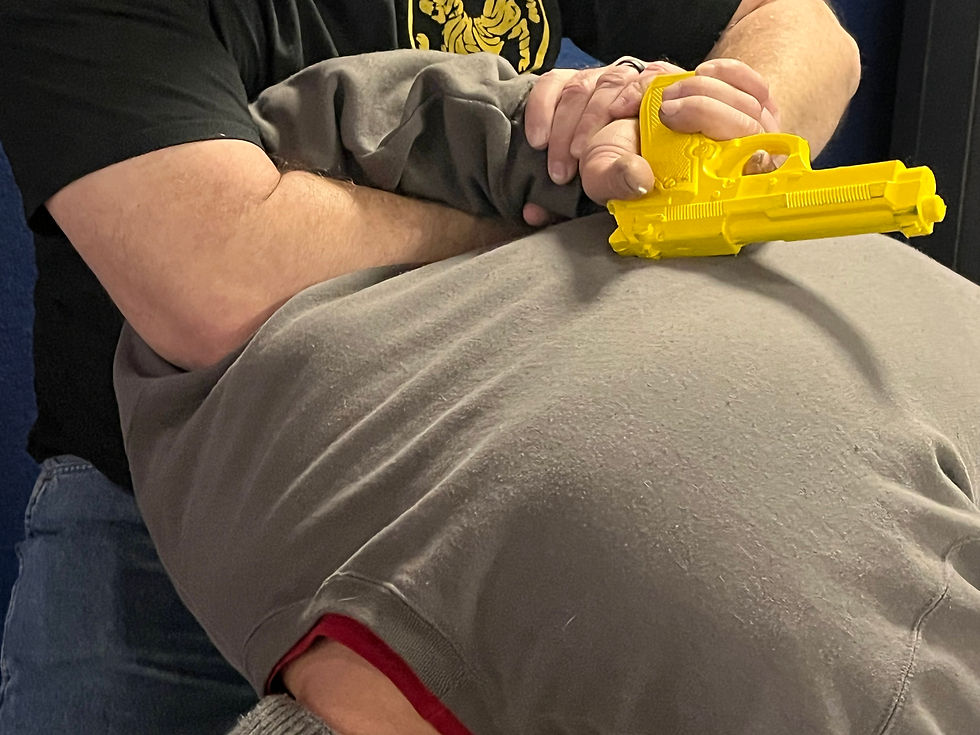
What to do? By having some training in defensive tactics from a seminar or having a background of martial arts training from a competent instructor you should have options. Having situational awareness as discussed in reason one is vital before attempting a firearm disarm. You do not want your disarm tactic to cause another person to be inadvertently shot. Equally important is knowing how to use verbal distraction methods, how to get off of the line of fire to avoid being shot, and how to control the attackers firearm by grasping the slide of the semi-automatic or the cylinder of a revolver to prevent repeated rounds being fired are nuggets of information that can prove vital in this scenario.
Attempting to disarm your attacker is not without risk. The alternative could mean certain death. Attempting a disarm gives you a fighting chance of survival. Only you can decide what to do and if you are confident and skilled enough to prevail. With no martial arts training or training in defensive tactics against a firearm there is a high likely hood that any attempt to disarm your attacker will not be successful. Would you want to roll the dice and gamble your disarm will work without having at least evaluated it in a training environment? I would not! Training for such a day should be considered with your EDC habit.
What about if you did manage to escape and disarm the initial gun wielding attacker, but as you attempted to grab your defensive firearm the attacker re-engages and tries to do the same to you? He grabs your holstered firearm. Can you successfully defend your firearms and prevent your own defensive firearm from being used against you? Remember every fight where you every day carry (EDC) introduces at least one firearm to the fight. You want to maintain your defensive firearm and keep it under your control at all times. Training on how to do this is just as important as the everyday carry (EDC) of your defensive firearm.
CONCLUSION
As we have discussed, martial arts training can enhance your defensive firearm everyday carry (EDC) skills and better prepare you to be more self-reliant as you work toward your self-defense goals. Simply having a Concealed Carry License and carrying a defensive firearm for self-defense may not be enough as deadly force is not always the proper and most reasonable use of force response. To stay on the right side of the legal system, having other options for self-protection that can be used in response to potential attacks should be considered and trained. If you are interested in receiving training in defensive tactics to add to your toolbox contact us at Self Reliance Self Defense to schedule a training session.


Comments